Leapgrog the high-voltage grid?
Every component and its dimensions must be questioned in order to optimize costs. Nothing can be taken for granted, everything could be completely different.
|
Why do we have an electricity grid?
|
At the end of the 19th century, there was only hydropower and electricity generation by heat-power machines. Hydropower was tied to geographical conditions, and large centralized thermal power plants are much more efficient than small decentralized plants. For mobile homes, there are tiny gas-powered generators with 7% efficiency, and the latest generation of Siemens CCGT power plants has 64% of the calorific value.
This tiny piston engine and this huge gas turbine, whose waste heat still drives steam turbines.
The logical answer: we need an electricity grid that connects producers and consumers that are far apart. But is this logic always and everywhere valid?
|
The refinement of "Hurray, the sun is shining" to 365/24 electricity
|
The first step is the refinement to 24 electricity using batteries. What does a home storage system in the 15 kWh range consist of? Typically 16 280 Ah to 320 Ah battery cells in a housing. What does a home storage system in the 150 kWh range consist of? Typically 10 blocks, each with 16 280 Ah to 320 Ah battery cells connected in series. What do many MWh large-scale storage systems consist of? Surprise, exactly the same basic components. They use exactly the same battery cells as the 15 kWh home storage system. There is no difference in efficiency between the 15 kWh home storage system and the 150 MWh large-scale storage system.
Why not just run everything on batteries to have 365/24 power? An old saying comes to mind: money has to work.
|
365/24 Solar power: money has to work
|
There are 4 reasons to store solar power:
- Short-term high power requirement - for example fast charging
- Earth's rotation - day and night
- Weather fluctuations - sunny and cloudy
- Tilt of the earth's axis - summer and winter
For the first 2 reasons, batteries have a clear advantage, for the last reason Power to X. The dividing line between batteries and Power to X is weather fluctuations. Why?
Money has to work. If such a battery has 200 full cycles per year and lasts 15 years, then at 60 €/kWh we would have: 60 / (15 years × 200 cycles) = 0.02 €/kWh in storage costs. Great, that fits! But if you size the battery large enough to cover the difference between summer and winter, then the service life might increase to 25 years, but €60 / 25 years = €2.40/kWh. That is absolutely not possible! The batteries are far too expensive to only work once a year.
What does a simple tank containing 1 GWh of thermal energy cost? That would be just under 200,000 liters of methanol. About 20,000 €. If a generator with 40% efficiency turns it into electricity, that's 400 MWh. Let's do a very simplified calculation for the entire Power to Methanol 300 kW equipment at € 300,000, tank € 20,000, generator € 80,000, to produce 400 MWh from 2 GWh of surplus electricity when needed: 400,000 / (20 years × 400,000 kWh per year) = € 0.05/kWh.
You have to multiply efficiencies in a chain. 50% power to methanol × 40% generator is a very modest 20%. But if the sun shines all day and the batteries are full, then power to methanol is waste utilization of otherwise unusable solar power.
In countries near the equator, a typical situation is 25% of solar power goes into power to methanol, which then generates 5% of the total electricity demand.
|
The more cost-effective technology depends on the latitude
|
This is true near the equator, where weather fluctuations are the dominant long-term storage factor and the tilt of the earth's axis plays a subordinate role. I, on the other hand, live in Austria 47.722° north of the equator. Here the difference between summer and winter is dramatic.
| Solar yield over 16 years in Europe
|
| 
| |
|
AAborg Denmark, Berlin, Koblenz, Salzburg, Rome and Corfu Greece. This is how different the solar yields were every day of the year from 2005 to 2020.
|
| Solar yield over 16 years
|
| 
| |
|
Amman, Cairo, Kathmandu Nepal, Kampala, Lawra Ghana, Timika Indonesia. This is how different the solar yields were every day of the year from 2005 to 2020.
|
A high-voltage grid, many cubic kilometers of underground gas storage facilities and large central combined cycle power plants already exist. Austria has 7 km³ of underground gas storage, which is 70 TWh or almost 8,000 kWh per inhabitant. The only thing missing is an order of magnitude more photovoltaics, 3 kWh of battery per kW of photovoltaics and power to methane. Both for Power to X and for electricity generation, centralized large-scale technology has advantages in terms of efficiency. These advantages are greater than the costs of a high-voltage grid.
|
Simulation from April 2024: halving energy costs for transportation?
|
We have carried out extensive simulations for 50 different locations and the hourly yield data from 2005 to 2020 with different loadings. Each of these different configurations was simulated with different loads. These simulations were designed to answer the question: is it possible to halve the energy costs for transportation and mobility using off-grid fast-charging settlements? With the battery prices expected in a few years, it is possible: Somewhere along a runway there are a few GEMINI next generation houses offering fast charging for 0.20 € / kWh.
Here are three application examples:
|
GEMINI house with 80 kW fast charger
|
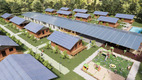
Without a power connection, but 80 kW of photovoltaics and 160 kWh of batteries enable the direct supply of an 80 kW fast charger. These houses, which are well distributed in remote villages, can make it possible for the first time to reach any point in Africa with an electric car.
|
Off-grid fast-charging settlements
|
A typical size could be 16 houses with 2 MW of photovoltaics and 6 MWh of sodium batteries. A 300 kW generator provides electricity even when it is very cloudy for days on end. As soon as cheap 300 kW power-to-methanol plants are available, surplus electricity can be utilized. Large trucks can also be charged quickly with 1 MW. On average, 6 MWh of electricity is sold every day. That would be, for example, 8 large trucks with 400 kWh and 70 cars with 40 kWh charging.
|
Cement for road construction with concrete
|
In hot countries, concrete is ideal for road construction. It does not get as hot as asphalt and, above all, does not become viscous like asphalt at high temperatures. But cement production is an energy-intensive industry. For example, the LEUBE cement plant near where I live requires 110 GWh of electricity and 400 GWh of thermal energy for 500,000 tons of annual production. You can also heat the clinker with electricity, which is more efficient, but this increases the electricity requirement to 360 GWh.
3 km² of energy-optimized settlement area can only operate a cement factory of this size with electricity. According to forecasts on the development of battery prices, this will be the cheapest production method in just a few years. Cheap batteries are the key to converting solar power into 24-phase electricity. Power to methanol is the key to refining 24 electricity into 24/365 electricity. |